
28 YEARS LATER (2025)
Streaming On Demand!
Directed by Danny Boyle.
Written by Alex Garland.
Check out the trailer here!!
28 years ago, the Rage virus spread across the UK like wildfire, causing everyone who came into contact with it to turn into snarling, sprinting monsters spewing blood in all directions in order to spread the contagion. 28 YEARS LATER opens with a young boy named Jimmy, hidden away with other children in a small home. Soon, it is obvious the infected are at the door and rampaging through the house. Jimmy escapes and flees to a church where is father (a priest) welcomes the infected into the church, believing it is God’s plan. Jimmy witnesses his father’s demise and escapes carrying a golden rosary his father gave him. Cut to 28 years later and we are now in a small community on an island off of the coast of Northern UK. The only connection with mainland is a land bridge that only appears at low tide. The dystopian community gives everyone a role to play in keeping them protected and thriving. Jamie (Aaron Taylor-Johnson) is a hunter who ventures to the mainland to scavenge for supplies and thin the herd of infected who may attempt to infiltrate the community. His wife, Isla (Jodie Comer) suffers from an unknown ailment and is bedridden. Jamie decides that even though he is only twelve, his son Spike (Alfie Williams) is ready to learn to hunt, scavenge, and kill his first infected. The first half of 28 YEARS LATER deals with this learning and bonding process between a father and son. But this is only the beginning of Spike’s journey to manhood as he encounters the landscape that has evolved with the virus for the last 28 years.
There is a lot going on with 28 YEARS LATER and I’ll try to cover as much as I can. Looking back on this series, the films were always much more than just your typical zombie film. And yes, I know many like to distinguish the threat in the 28 DAYS LATER franchise as the infected instead of zombies, but even in 28 YEARS LATER, the term zombies are used and the people these infected are no longer there, so while I understand the distinction, I will put the franchise in the zombie subgenre of horror. If you don’t, that’s cool. But I do.
This franchise has been more than just zombie survival. The first one seemed to be about hope after a time of crisis. There were absolutely horrifying things that occurred in 28 DAYS LATER, but it ended on a very positive note. Jim and the crew had survived the horror and were hopeful when an airplane passes overhead. There seemed to be some kind of end in sight to the horror. If this were a 9-11 allegory, something quite a few zombie films were at the time, it was director Danny Boyle at his most optimistic, a time where hope may be on the horizon.
Then 28 MONTHS LATER came along and it was apparent that our response to the tragedy was to basically “nuke it from orbit.” The heavy attention to military, while also showing how a family, even the most loving one, can betray one another, showed a more pessimistic view. Our baser instincts took over and instead of searching for a cure, which may be out there in some that have an immunity to the virus, the preference by the higher-ups to destroy rather than investigate prevailed . Of course, despite many desperate efforts by the military to contain the virus, it still persisted, spreading to France in the final moments. That…was not such a chipper ending. Pretty bleak, if you ask me.
That brings us to 28 YEARS LATER, and as with the previous two films, the opening moments tells a lot about the themes explored in the film. 28 DAYS opened with a well-intentioned humanitarian effort to free chimps tested on labs causing an outbreak and ended with a positive note for humanity. 28 MONTHS began with an act of betrayal to the family and ended in a failure of the military to fulfill their promise to protect. 28 YEARS begins with another family attacked and a boy witnessing its destruction with his own father, who he followed devoutly, showing some misguided beliefs. 28 YEARS opens with the boy Jimmy going against his father’s words and does not embrace the infected attack. This is basically the story we see play out through the rest of the movie with Spike as he learns from his father, then has a moment where everything he believed was true, in actuality, is a lie, forcing Spike to take action on his own and seek answers when his faith in his father is lost. Again, a powerful message.
The first half of 28 YEARS LATER is as intense as can be. We are introduced to the fragile society, marked with signs and lessons everywhere reminding the community that all the resources are everyone’s and not to waste it. Water is portioned. Food is free. Everything is shared, as long as the rules are followed. While many would look at this as some kind of socialist political statement, I don’t know if that’s what Boyle, writer Alex Garland, and this franchise are going for. There is still an anti-war message continued from 28 WEEKS, but I also think they are saying that militaristic action is necessary, as well as ugly, as represented by the inclusion of the amazing reading of the poem “Boots” by Rudyard Kipling, over a montage of society through the ages taking brutal military action in order to persevere.
Sidenote: while the “Boots” poem is amazingly edited in the trailer and through the 28 YEARS LATER film, I have to give the HORROR IN THE HIGH DESERT found footage series credit for using the poem first in a horror movie. The terrifying poem shows up in the final moments of the first film and again, evokes sheer terror.
But Boyle, Garland, and the film seems to show that in order for a society to function, both hawk (militaristic) and dove (compassionate) attitudes are necessary. Then again, I am basing all of this on my experience with American politics. Being set in the UK, Boyle might have an entirely different message about his own government across the pond. Sadly, my knowledge of politics outside of the US is limited, so I may be way off with my analysis. Most likely, I am.
Boyle has said in interviews that 28 YEARS LATER is about “Family” and when I heard that, I automatically thought about the kumbaya sort of family message we often get in Hollywood movies. But, sorry Vin Diesel, that’s not the kind of family 28 YEARS is about. I think Boyle and Garland are telling a more realistic, pessimistic message of how a child grows to an adult and in order to do so, he has to leave hid mother and father behind. Typically, one learns survival from the father and compassion from the mother. The amount of what one gets from each parent shapes the child into the adult the child becomes. At least that’s the way it was done for many, many years before we got all smart and modernized. This is true in 28 YEARS LATER as Spike learns the skills of survival from his father but still has the naïve dreams of a child encouraged by his mother. As his mother, Isla, lays sick in bed, Spike is taken, a bit too early, by his father to perform these more brutal trials to become a man. Most likely, if Isla were more present, she would have told Jaimie to go fuck himself and wait until the boy is older. But she isn’t and Spike and Jaimie go out into uncharted territory.
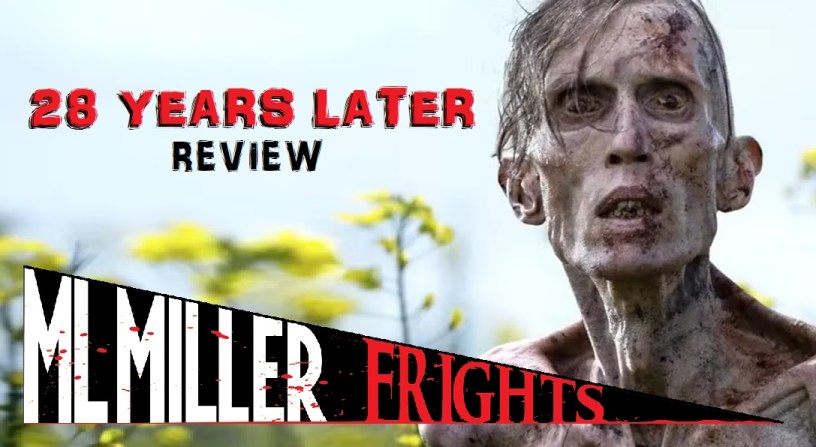
I love the way the landscape has evolved in 28 YEARS LATER. The way nature has taken over most places, covering houses and stopped trains with vines. The film definitely is more expansive than any other zombie film has depicted the post-apocalypse before. The threats have evolved too with the infected basically becoming feral humans who have shed their clothes and sprint after anything that moves. Some of the more out of shape infected have become human slugs, slithering across the forest floor and eating anything that they come in contact with. They aren’t exactly slow zombies, but they are an added threat as they move silently and are just as infectious and hungry as the fast ones. But the biggest and more terrifying threat is the Alphas; giant infected man-mountains, all hair and muscle, towering over the rest of the herd and somehow leading them. These monsters have some form of higher intelligence and though they are nothing like Romero’s Bub from DAY OF THE DEAD, they are a bit more aware of their surroundings and are more intuitive to spreading the virus and their own survival.
This first half wonderfully establishes that the threat has grown and adds new life to the already treacherous landscape. Boyle takes his time, adhering action to the lessons Jamie teaches Spike as they traverse the countryside and rotten buildings in the first half. While we’ve seen the threat of the infected before, never has it been so diverse and more dangerous. While Boyle and Garner is telling us a poignant tale about a father teaching his son to be a man, this is also an intense and action-oriented way of introducing this new world to the audience.
The film makes a dramatic shift midway as Spike realizes his father’s teachings are important, but also much of it is sullied up with false bravado and outright lies. The first half is marvelously edited and filled with big-budget action sequences that really got my heart pumping. Never to the point of where it was during the “In the House In a Heartbeat” sequence in 28 DAYS, but a few scenes, like the land-bridge sprint sequence, came darn close.
This is when 28 YEARS turns into a much more somber and thoughtful piece about life and death. And while I understand why mainstream audiences might not take to that, I felt this is where the film becomes so much more than your typical zombie survival flick. This is a bold move for filmmakers as you always risk losing the audience when there’s a tonal shift mid-movie. But like FULL METAL JACKET with its intense and most memorable first half, the second half tonal change is what completes the message Kubrick is trying to tell and I think the same goes for what Boyle and Garner are going for in 28 YEARS LATER, which doesn’t shift that tone once, but twice. It’s a wonder anyone was still with the film by the end, and I think that’s the reason many of those who dislike the film hang their hat on. . The threat is consistent with the infected, but our understanding of that threat changes. And along with it, so does the character of Spike.
In the latter half, Spike rejects his father Jamie, pulling away from him and sets out on his own. He is not quite a man, but Spike knows enough to understand he doesn’t want to be like his father and chooses to take action on his own.
And this, my online friends, is where things got personal for me. And it’s also going to be very spoilery from here on out.
I lost my father at the same age as Spike does is in the film. And, yes, I know Spike’s father doesn’t necessarily die, but when he leaves the island community behind and looks to find someone to save his mother, Jamie might as well be dead. It is right here in the film where I couldn’t help but identify deeply with Spike’s magical thinking that at the end of his noble quest lays the treasure he desires—to get his mother back. But again, this mythical concept of family is not the Hollywood tale. There is no knight in shining armor rescuing the princess. This section focuses on the cold, hard fact that everyone racing around infected was once a human being with loves, losses, thoughts, wins, and loses. This message is communicated through a wonderfully soulful performance by Ralph Fiennes as the iodine-covered Dr. Kelson. Kelson has built a monument of skulls of all of the infected he has encountered—a task that has made him an outcast among the rest of the community, but one he has dedicated his life to. It is with Kelson that Spike learns that every life is precious, even the infected.
Now, Boyle and Garland do a lot to pull on the heartstrings here. You’ve got the sick mother. The wide-eyed kid you followed for more than an hour. Then there’s the amazing cinematography with a golden sunset, and an overwhelming swell of music. While the threat is still present, the film takes a moment to slow down and acknowledge one single death in one especially gracious act of letting go. Sure, its surrounded by the sprinting infected, rampaging Alphas, and sluggish crawlers, but the moments Boyle gives Spike to come to acceptance of his mother’s fate were some of the most touching you’re going to see in a horror movie ever. It is a bold choice for Boyle to end the film in this way, especially after a pulse pounding first hour. But in doing so, his extensive examination of death and how it affects different aspects of humanity with this series has been some of the most sophisticated ideas that are rarely broached in the genre.
Seeing this scene hit me hard, more so than I could have imagined and more so than I really like to express in such a public place as a theater or in an online review. But watching this young boy say goodbye to his mother struck a chord very close to home, too close to my current situation with my own mother.
I want to go on and talk about the way the film was shot using multiple iPhones, but honestly, while the shots looked amazing, especially the way the film shifts its focus and slows down the moment, even freeze-framing it for a bit, that could be looked at as flashy bells and whistles anywhere else, but in a movie series that has never looked conventional, it is what I expected. I really know very little about camera lenses and screen formats and the like. I’ll let other people dissect that. All I know is that everything looks unique, but that has been another constant factor through the 28 series. Boyle not only made a movie that hit me like a Mack truck but turns out it looks nifty too.
I also wanted to acknowledge the wonderful performances. Aaron Taylor Johnson has become one of the better leading men in movies right now. Here he plays a flawed man, trying to do his best to raise a son that will be able to survive in this harsh world. It is rather one note, as he does represent the aggro-tough guy, something that this movie and Spike doesn’t necessarily want to become, but he does the role very well and gives him much more nuance than the character deserves. Like Johnson does with fatherhood, Jodie Comer plays more of a symbolic aspect of motherhood, representing compassion and morality, as well. Half of the movie she is delirious and bedridden, but aspects of both why Jamie was drawn to her and why Spike is fighting for her come through in the latter half. It is a selfless role where she too is not put in the best of light at times, but Comer makes it her own. And again, while Ralph Fiennes is more of a representation of a lesson Spike needs to learn at this point of his journey, he always offers up a confident performance as the outcasted doctor. His sincere performance is mostly expository, but the words he speaks resonate and shine. Lastly, the performance of Alfie Williams as Spike was one that had to grow on me. At first, I was annoyed with the child actor. I thought he was the weakest part of the beginning, but then I realized that his awkwardness and reluctance was purposeful. Like his character Spike, Wiliams grows as a character and ended up growing on me too. In the final dramatic moments, the little actor really does a fantastic job, showing real change since we met him in the beginning.
Oh yeah, that ending. Another tonal shift from a meditation on mortality to a balls-out, almost slapstick farce with a blonde-haired, track-suited gang of thugs leaping to Spike’s rescue. I know only bits about the Jimmy Saville controversy. I know he is a despicable man who did heinous things. I also know that this probably resonated differently in the US, with most audiences oblivious to his crimes. But even without at first understanding it, I felt this shift in tone was mostly done to usher in the next chapter of the 28 YEARS LATER franchise. Some might feel it undercuts the tone of the film. But I needed that cathartic laugh out loud after the second half ended and can’t wait to see where this versatile series is set to go next.
I don’t want to get all preachy or anything, but in a genre where death is so common, sometimes we become jaded upon watching one person after another murdered by the slash of a serial killer or the claws of a monster. I know not every movie needs to make every character precious. I love those 80’s movies where people fell like bowling pins. But 28 YEARS LATER made me take a second and look at death a little closer. The fact that this horror genre—a genre that many look down on can make me feel such strong emotions is part of the reason I watch horror to this day. 28 YEARS LATER is the zombie movie I needed at the time I saw it. My mother allowed me to watch all of those horror movies as a kid. She helped form the lifetime horror-phile I am today. For that, I am forever in her debt. If you made it to the end of this video, thank you. I also appreciate your support of this channel. It would be nothing without my loyal followers. I’m going to try to up the output on this channel soon and of course, this October’s Best of the Year Countdown is coming up. So there’s that to look forward to. I’ll see you next time, folks.
Like, Share, and Subscribe already!!!
Help me out at my Patreon page here – https://www.patreon.com/MLMiller
Read written reviews and my comics news at https://mlmillerwrites.com/
Follow me on Twitter @Mark_L_Miller
Want some spooky comics? My two new trade paperback collections of PIROUETTE and GRAVETRANCERS are out now! Please show your support and let your comic shop know you NEED a copy! If they’re out, tell them to order more!
You can find your local comic shop on the Comic Shop Locator. https://www.comicshoplocator.com/
Music Written by Tim Heidecker
Music & Arrangement by Bonnie ‘Prince’ Billy https://youtu.be/PDySbxQgZMg
(I do not own this music)
 MLMILLERWRITES / MLMillerFrights