
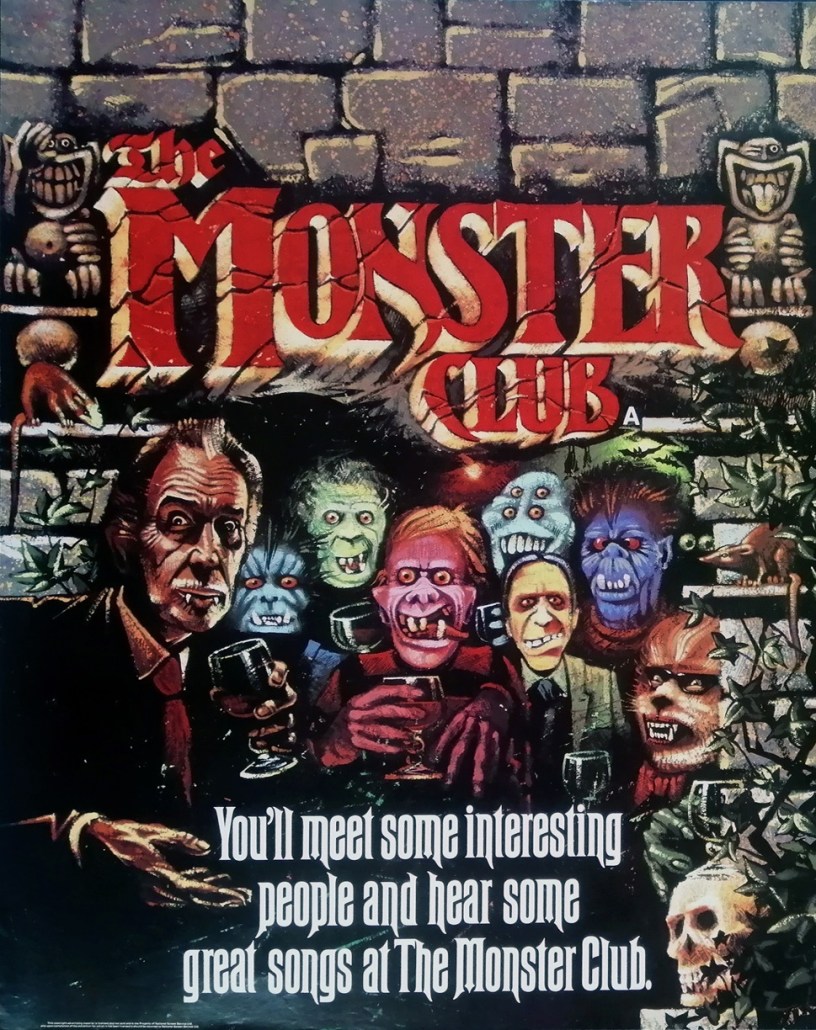
THE MONSTER CLUB (1981)
Streaming on Tubi!
Directed by Roy Ward Baker.
Written by R. Chetwynd-Hayes, Edward Abraham, Valerie Abraham.
Check out the trailer here!!
One of the odder anthologies of old is THE MONSTER CLUB, it came long after such classic British anthologies like TALES FROM THE CRYPT, VAULT OF HORROR, and ASYLUM, but the film still has British horror familiar faces like John Carradine, Donald Pleasance, Britt Ecklund, Simon Ward, Stuart Whitman, Patrick McGee, and of course, Vincent Price. It was also directed by ASYLUM filmmaker Roy Ward-Baker and ended up being his final picture. It also should be noted that unlike many anthologies today, THE MONSTER CLUB was all directed by one person, which in the end gives the film a much more even-keel feel to it. That doesn’t mean it’s any better, but all of the segments really feel like they have the same tone and themes, which you can’t say for a lot of anthologies today.
The wraparound of THE MONSTER CLUB is almost quaint watching it now, with a hungry vampire Eramus (Price) seeking but a sip from a random passerby/famous horror author/writer of this very movie, R. Chetwynd-Hayes (Carradine). As a way to repay him, Eramus brings the horror scribe to a secret underground bar called the Monster Club, where ghouls can hang out and dance while monsters mash to a handful of modern bands that represent the underground and experimental music scene of the UK at the time. It’s all quite the graveyard smash!
In the wraparound, Eramus explains the genealogy tree of monsters, as all monsters are descendants from three types of classic monsters; the vampire, the werewolf, and the ghoul. Combinations of these creatures of the night are discussed and I’m surprised more films haven’t tried to use these various combinations to make new kinds of monsters in the horror genre. The stories of this anthology are derived from examples of further down on the genealogy chart. It’s interesting that the Monster Club would have a genealogy chart in it, given that it appears to be an underground club where different types of monsters covort whilst dancing, drinking, and partying. It’s almost as if the chart is there to let the frisky monsters know what their various hookups might sprout, which in itself is kind of funny as well as a bit of a moralistic comment on the party-culture as a whole.
Story one tells the tale of a creature called “The Shadmock,” a lower level monster with a gaunt face and a devastating whistle. The tale stars Simon Ward (from FRANKENSTEIN MUST BE DESTROYED, THE THREE MUSKETEERS, and DOMINIQUE) as a con man and THE OBLONG BOX’s Barbara Kellerman as his accomplice, who attempts to seduce and rob a wealthy recluse named Raven (James Laurenson), who happens to be a Shadmock. Though she is disgusted by his strange looks, Kellerman continues her ruse, not knowing of the Shadmock’s devastating power. While the story is rather simple and predictable, I simply love the idea of a Shadmock, which seems like a more human version of a banshee. This segment also has a masked ball of monsters, a rascally cat, and some great melted face effects for its time.
Segment two is called “The Vampire” or “From Beyond the Tombstone,” which tells a goofy story of a vampire (Richard Johnson from THE HAUNTING and ZOMBIE) who marries a human woman (Britt Ecklund from THE WICKER MAN) and has a child. This one is a pretty short and sweet cautionary tale for vampires to never talk to men with violin cases. I won’t spoil the reason why, but of course, three men; one of them Donald Pleasance, show up. Pleasance eats up the scenery and makes this one worth watching, but man, does it end with a comedic plop.
The third and last segment, called “Humgoo,” features a story about the child of a ghoul and a human, known as, of course, as a Humgoo. While this one is another predictable story, there are some great sets and more than effectively low-key makeup effects when a director (Stuart Whitman from EATEN ALIVE and NIGHT OF THE LEPUS) goes out to scout a location to find a desolate town to film his next horror movie. He happens upon the perfect setting, but it’s a town that is inhabited by ghouls who have eaten all the dead in the local graveyard and are famished for new visitors. This segment has some fantastic art by John Bolton giving form to a tale told in flashback about the first ghoul. The art was the highlight of this segment, that and the appearance of Patrick McGee as the lead ghoul.
One of the more lovable features of THE MONSTER CLUB are the pop musical acts between stories. The first is a pretty lame song by The Viewers called “Monsters Are Okay” which reminded me a little too much of Tommy Twotone’s “Jenny-867-5309.” Things get better with B.A. Robertson who sings “A Sucker For Love,” which was actually a solid song. Robertson went on to sing the infectious “Bang Bang” and co-wrote “The Living Years” with Mike and the Mechanics. But my favorite song comes from the band called Night entitled “The Stripper,” which talks about being a stripper, but maintaining her dignity. The song’s set to a woman stripping off her clothes in silhouette, eventually taking off her skin, and finally becoming a dancing skeleton. The song rocks and paired with the animated dancing skeleton, it’s gold. Finally, UB40 provides the final song over the credits, but don’t appear in the film. I have to give THE MONSTER CLUB some credit for cashing in on the new MTV trend that premiered in the same year of its release by adding a musical aspect to the film, but it does feel like a bit of a cash grab to nab younger viewers to come see these old British actors try to scare you.
The scares are sparce and I wouldn’t call THE MONSTER CLUB a great movie by far. The budget is also very, very low, as evidenced by the simple Halloween masks worn by the monsters in the Monster Club. Still, I think I admire it more by the ideas that sprung into my head while watching it than the movie itself. Apparently, the real writer of the film was disappointed that the film veered so far from the original stories. Might have to track those tales down. In the meantime, as an appreciator of old school horror, especially British horror from the 60’s and 70’s, THE MONSTER CLUB was a lot of fun despite its lame comedy and weak scares.
 MLMILLERWRITES / MLMillerFrights