
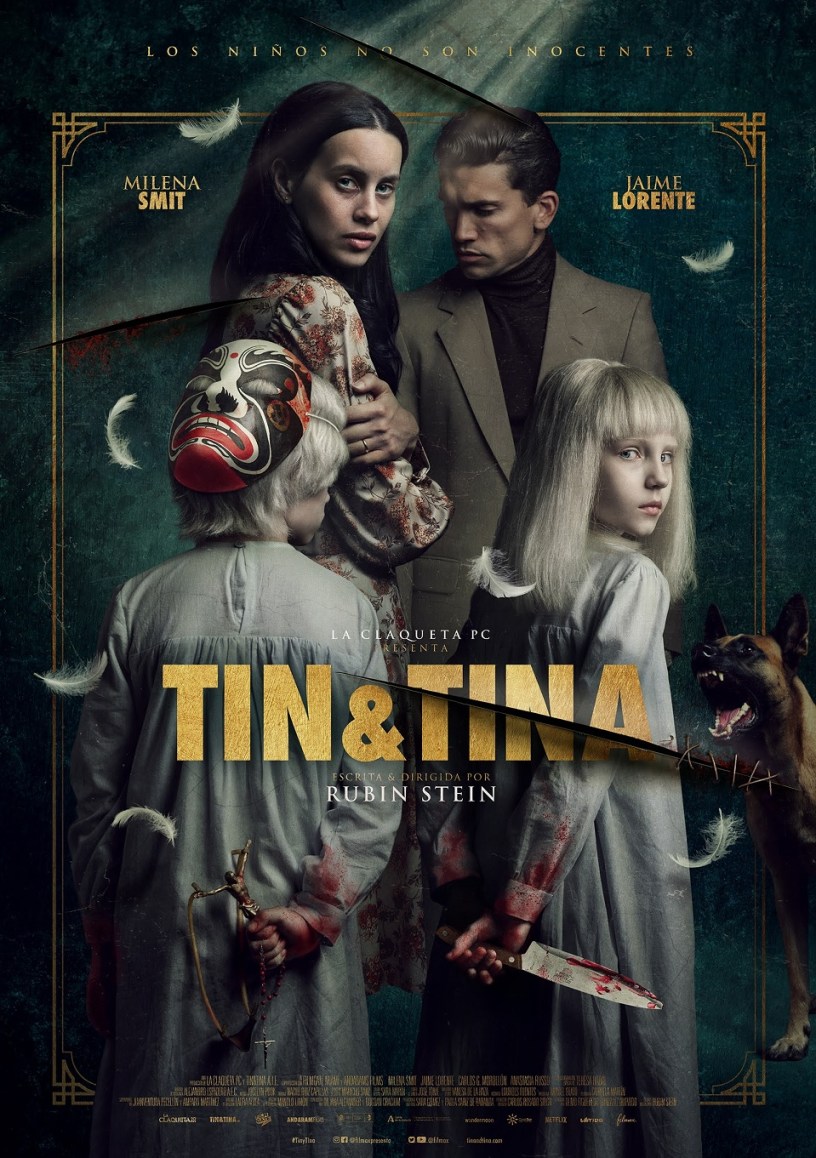
New streaming on Netflix!
TIN & TINA (2023)
Directed/written by Rubin Stein.
Starring Milena Smit, Jaime Lorente, Carlos González Morollón, Anastasia Russo, Teresa Rabal, Sergio Ramos, Joserra Leza, Luis Perezagua, Antonio Figueredo Manrique, Chelo Vivares, Ruth Gabriel
After experiencing a miscarriage on the day of their wedding, newlyweds Lola (Milena Smit) and Adolfo (Jaime Lorente) decide they want to adopt. They meet albino twins Tin (Carlos González Morollón) and Tina (Anastasia Russo) at the local orphanage, run by Sister Asuncion (Teresa Rabal) and immediately decide to bring the pair home to live with them. But even on the ride home from the orphanage, the twins begin to exhibit strange behavior. They are devout believers in the Bible, but lack the maturity to discern it as a book of guidance and not fact. This literal understanding of the Bible begins to wear on the non-religious couple and strange and unfortunate occurrences start happening in and around their home.
TIN & TINA is your typical evil child movie. It is littered with details that have become cliched through the years of bad kid movies and horror movies for that matter. This is not a badly made movie. There are quite a few well constructed scenes and shots that are quite mesmerizing. But these moments are punctuated by things we all have seen in too many movies.
First off, whenever you see an animal in these types of movies, in the past, that means the dog/cat/gerbil/whatever is toast. It’s a trivial way to evoke sympathy to have a trusted animal murdered just to up the threat level or kill count. Modern Hollywood movies seem to have gotten the point and the ironic thing these days is to have the animal in peril, but somehow come out without a scratch by the end. I’ll take that any old day. But Spain doesn’t seem to have gotten the memo and when the dog that dislikes the kids is introduced, the label dog-meat almost appears above the poor pooch’s head. It’s just cheap and an aspect of horror that I hope continues to dwindle in appearances.
The kids alternate from being angelic to creepy pretty easily. It helps that Tin (Carlos González Morollón) has a strained smile stretched across his face most of the time. Tina (Anastasia Russo) is the more savvy of the two, and while these two seem to hide behind the veil of innocent misunderstanding of the word of God, there does seem to be a more devious side to their actions. While killer kid films are a dime a dozen, TIN & TINA at least offers up a religious angle to the mix that separates it from the norm. I guess if I had to compare it to something, I’d say it reminded me a bit of ALICE SWEET ALICE in the way it incorporates religious iconography and warped religious beliefs into the narrative.
Still, every other cliché occurs outside of that. Adolfo is an airline pilot meaning he is constantly away from home, so of course, when Lola expresses concerns about the two creepy ass children, he doesn’t believe her and dismisses her worries. For once, I wish the husband would listen to the concerned mother and they would just drop the kids off someplace far away and never return in these kinds of films. But no, the woman is left to fend for herself against the absent husband. I guess there most likely is some kind of comment there about the differences in parenting and the role the mother and father play in a child’s life, but it’s such a trope that I just roll my eyes when I see it and don’t want to waste brain waves to try to get to the bottom of this tiresome cliché.
TIN & TINA is not a total wash. There are a few scenes I found to be quite shocking and disturbing, as when the kids attempt to see god by trying to strangle each other with a paper bag and get as close to death as they can. I wish there were more scenes of this nature so as to set this apart from others in the evil child subgenre. But apart from the heavy religious overtones, there’s not much distinguishing it. On top of that, this film’s got a two hour runtime and believe me, you can feel the drag all the way through. A good forty five minutes would be shaved off and it wouldn’t even effect the plot. The music is truly odd in this one. A lot of the songs contradict the events going on in the movie. The irony of some of the instances works, but other times it makes for an weird juxtaposition. On top of that, there’s a scene where Tin & Tina act out an Asian song for their mother and pull their eyes back to look like Asian kids. In this culturally charged day and age, I was surprised to see it appear on Netflix, which has proven to be hyper-sensitive to that sort of thing.
For some reason, TIN & TINA is set in 1981 Spain, after a bloody political revolution. But not knowing many details about the occurrence, the gravity of why the story is set in this era went over my head. I guess the film might have had something to do with the end of one set of beliefs or politics and the beginning of a new one, and that blood needs to be spilled for any kind of real change to occur. I can see that theme working, but it is so scant in the actual narrative, I think it could have been one of those details edited out and it wouldn’t even have affected the movie.
If you’re looking for textbook horror that you’ve seen time and time again, TIN & TINA is there for you. Sure, the kids are creepy, but really, it’s nothing new. While the film bares its teeth occasionally, it’s adherence to so many cliches really makes it ultimately forgettable.
 MLMILLERWRITES / MLMillerFrights
I’ve worked in this industry for decades, several emmys, have been lucky enough to work on some insanely huge budget films and I can say, Hollywood has a subset of known but never said rules on deaths in movies. While these rules are in a constant flux, especially if something horrific occurs in current events (regardless of when the film was shot or when it’s set, nee Ryan Gosling/Gangster Squad).
In every writers meeting, prepro and script lock on a horror project, it is always
(#1) only one child death per movie
(#2) an attack of violence (approx) every ten to eleven minutes
(#3) in a mixed cast, never a slant towards one ethnic or gender class
(#4) individual deaths may be bloody, but the higher the count in any one scene, the lower the amount of blood (from Arnold an Commando to again the practically bloodless Wick4)
(#5) the more positive a character, combined with a strong societal background (doctor, cop, priest) the harder it is to kill them
(it took until Scream 5 and Dewey’s police retirement before they could off him)
I agree with you on the typical animal victim setup and was pleased after Nuts made it to the end of JWick 4, that pendulum will swing back and I can see him not making it thru p5 or spinoff, bc producers always want to raise the stakes.
Obviously there are always exceptions to rules an the better the filmmakers, story an director, there are ways around each one, but with every break in the rules, you take a risk
One can go rogue and make a Serbian Film or Bunny Game, just don’t expect it to be seen by many
LikeLiked by 1 person
Thanks for the awesome message. I completely agree, these unwritten or written rules are pretty much the template of films, one that has been followed by decades. Being a person who appreciates those who step down new paths, I see this list almost as a challenge to make breaking these rules work, but understand why they exist. The dog death thing is so cheap and having lost both dogs and cats through the years, really are effective, but a cheap way to garner sympathy because of just that. It feels like the equivalent of a cat jumping through a window scene or killing the black guy first. These cliches have been parodied and addressed for years now and when one of them happen, they are either looked at as archaic. I think that’s why I am not really looking forward to The Blackening because it is addressing a bad trend in horror that seems to have been over with for over a decade or two and addressed in films like SCARY MOVIE, GET OUT, and other high profile movies.
LikeLike